Christianity crosses every kind of barrier: political, religious, ethnic, economic, geographic. This struck me for the first time 30 years ago, during the last winter of the war in Bosnia. I was on my way to Sarajevo and made a stop for supper with a Croatian friend who served as pastor for a little church near the front. I was in the middle of a vast killing field in which the ethnic cleansing of Bosnians, Croats and Serbs had displaced two million and killed 100,000.
Over dinner the Croatian pastor introduced me to two families, newer members of his congregation. One couple was Serbian, the other Bosnian. Around the table they told me how the Gospel had reconciled them to God and, therefore, to each other. Each had family and friends murdered or homes destroyed by the ethnic groups of the others around the table. Now they were brothers and sisters in Christ. Each was still a Croat, Serb or Bosnian, but they were also, in a real sense, family.
In the decades since, I’ve seen this reality again and again. It’s happening all the time, everywhere on the globe.
A few years ago I had an idea: Travel around the world, and on the first day of each week, worship Christ with a new group of believers in a new place. A cancer diagnosis forced me to shelve the idea. Once I got through that ordeal—months of chemotherapy, a bone-marrow transplant—I took the task up again, this time with new zeal. I had no guarantee of more time on earth.
I set out with a friend, the Canadian pastor and writer Tim Challies, in February 2023. We started in the Pacific at the International Date Line in the Kingdom of Tonga. This was to underscore the literal truth of Psalm 113:3: “From the rising of the sun to its setting, the name of the Lord is to be praised.”
From there, we tracked westward. In Fiji, we worshiped with native islanders and ethnic Indians. Their singing, praying and preaching moved seamlessly among three languages: Fijian, Hindi and English.
Next, we gathered with an Anglican congregation in Sydney, Australia, and the following Sunday with Presbyterians in Seoul, Korea. They prayed in chorus—forcefully, tearfully—as if, like Jacob of old, they were wrestling with God.
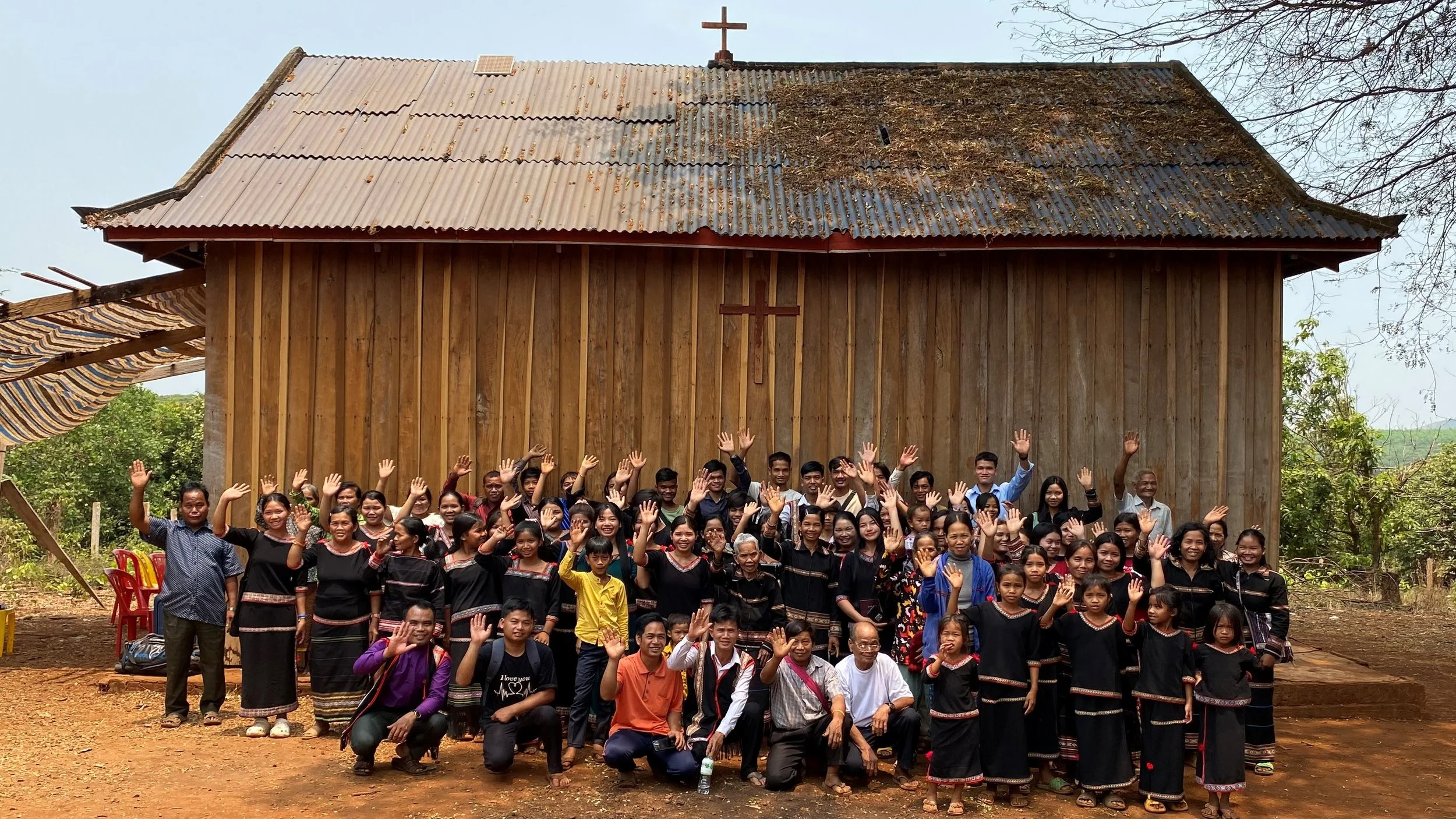
We traveled from those high-rise cities to our next church in a Cambodian village at the end of a dirt road where first-generation Christians celebrated Easter with singing, tribal dances and preaching on the proofs of the Resurrection, the power of which was on beautiful display in their faces and voices.
From there we went to Zambia to another off-the-grid church. It was baptism Sunday with 16 receiving the sign. After each one emerged from the water, there were whoops and songs of joy. Though I don’t speak Bemba, I could clap in Bemba.
Then we flew north to Poland, where a little church with a big heart had taken in 60 Ukrainian refugees who had fled the war. The church doors were opened to them, and its rooms were outfitted into bedrooms, bathrooms and kitchens. I thought of Hebrews 13:2: “Do not neglect to show hospitality to strangers, for thereby some have entertained angels unawares.”
In Morocco we worshiped in an apartment. The Christians who gathered in that house church are a handful of the millions of believers from North Africa to North Korea who gather every Sunday to worship Christ despite persecution. Many must gather secretly, careful not to arrive all at once or sing too loudly, lest mobs or police hear about it.
We continued westward, crossing the Atlantic to Brazil, to a church in Recife that has tripled in size since Covid. I asked the pastor, “How did this happen?” He smiled and replied: “Nós apenas pregamos a Bíblia,” “We just preach the Bible.” From there we hopscotched to Chile, up to Mexico City, and then out to Alaska’s remote Aleutian Chain, where a sturdy, generous band of believers make their living off the Bering Sea. We worshiped and fished together.
The worldwide church is a spiritual family, not a manmade institution. In a world of tribal hatreds and ancient resentments, the Gospel unites people in bonds of love who might otherwise have every reason to treat each other with suspicion. I’ve learned that, by God’s grace, what I thought was an extraordinary phenomenon 30 years ago around that table near Sarajevo turns out to be the most common thing in the world.
This article first appeared in the November 28, 2025, print edition of the Wall Street Journal as 'Worshiping God at the Ends of the Earth'. Copyright ©2025 Dow Jones & Company, Inc. All Rights Reserved.